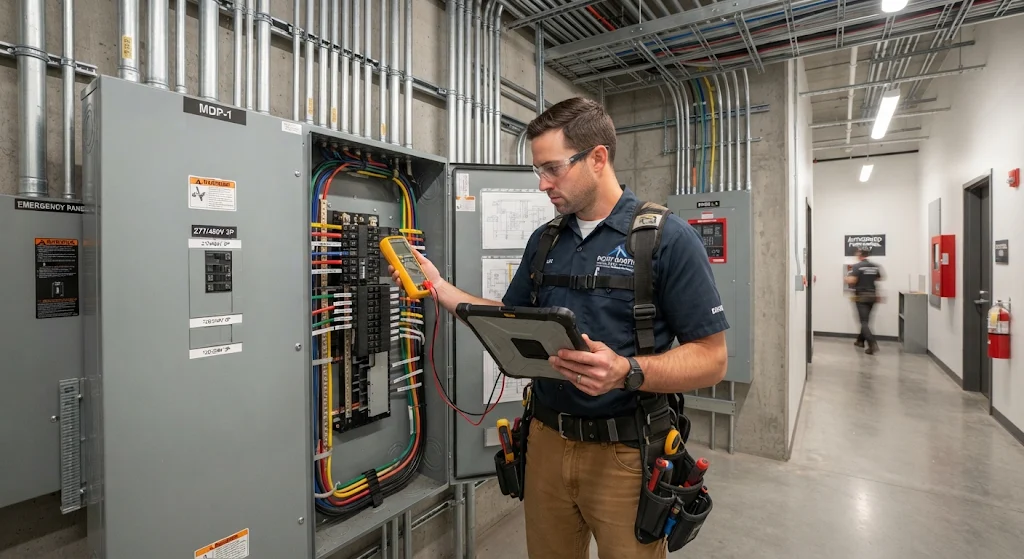
Electrical Panel Upgrades & Service Modernization in Troy, MI
The electrical service panel is the central nervous system of any residential or commercial property. In Troy, many properties built prior to the 1980s continue to operate on legacy 60-amp or 100-amp electrical panels. Modern lifestyles—fueled by electric heating, high-efficiency appliances, home offices, and electric vehicle adoption—readily exceed the operational thresholds of these vintage systems.
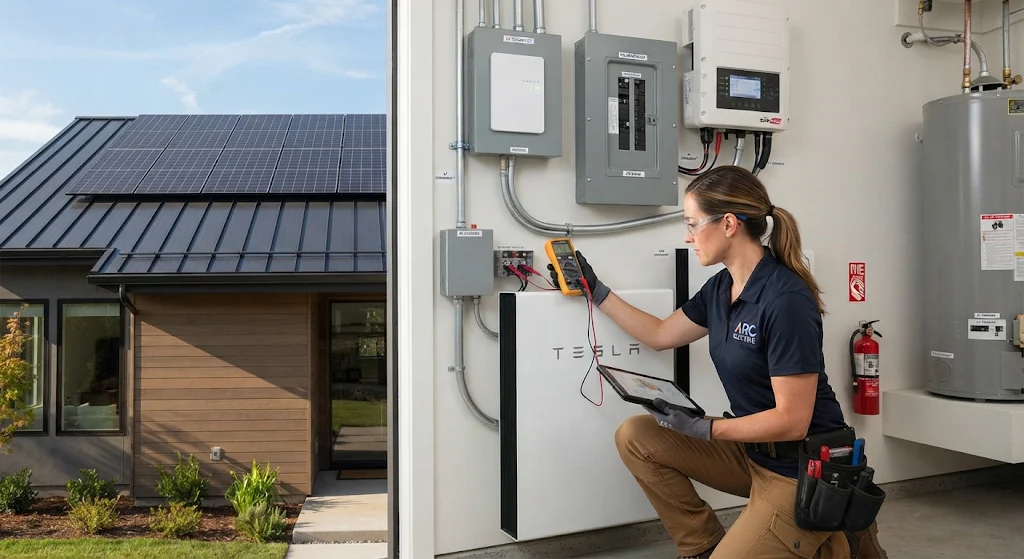
Signs Your Panel Requires an Upgrade
Upgrading your electrical service becomes necessary when facing capacity restrictions or safety hazards:
- Insufficient Available Breaker Spaces: Having no open slots for new circuits often leads to dangerous "tandem" or double-tapped breakers that violate electrical code.
- Legacy Fuse Boxes or Obsolete Panels: Fuse boxes and certain discontinued panel lines (such as Federal Pacific Electric Stab-Lok or Zinsco) have documented design deficiencies and breaker failure rates.
- Planning Major Electrical Additions: Adding central air conditioning, a finished basement, a hot tub, a heat pump, or an EV charger demands dedicated 30A-60A circuits and adequate service headroom.
- Panel Deterioration & Corrosion: Moisture intrusion, rust along the bus bars, or scorching on breaker contacts indicates immediate replacement necessity.
Service Replacement vs. Panel Replacement
A simple panel swap replaces the interior breaker box while retaining existing service entrance cables. However, upgrading total service capacity (e.g., from 100A to 200A or 400A) requires replacing the exterior meter socket, service mast, utility conductors, and grounding electrode system (ground rods and water pipe bonding) to meet Michigan Part 8 Electrical Rules.
Local Permitting & Utility Interconnection in Troy
Administered by the City of Troy Building Inspection Department. Commercial tenant finishes and complex residential loads require electrical schematics and formal on-site code inspections.
Executing a service upgrade mandates a coordinated power shutoff and reconnection with the local utility provider (Consumers Energy or DTE Energy). Independent licensed contractors coordinate the utility disconnection, pull the required municipal permit, execute the physical upgrade to code, secure the municipal inspector’s green tag, and authorize utility power restoration.
Upgrade Your Electrical Service in Troy
Contact WATT911 Michigan connection dispatch at (888) 605-9975. Connect with an independent licensed contractor to calculate load requirements and plan your electrical panel modernization.
Questions to Ask Before Upgrading
Before proceeding with an upgrade, inquire about total load calculations, whole-home surge protective device (SPD) integration (now required by current NEC codes), subpanel options, and warranty coverage on the installed equipment.
NEC Article 220 Load Calculation & Grounding Electrode Modernization
Executing an electrical panel upgrade requires comprehensive engineering calculations before equipment selection. Under National Electrical Code (NEC) Article 220, contractors perform formal load assessments accounting for general lighting loads (calculated at 3 volt-amperes per square foot), dedicated small appliance circuits (minimum two 20A kitchen circuits and one 20A laundry circuit), and continuous motor or heating equipment factored at 125% of nameplate rating. This mathematical calculation proves whether a standard 200A (48kVA) service suffices or if a 400A (96kVA) service is necessary to prevent continuous overload.
Equally critical is modernizing the grounding electrode system (GES) to comply with NEC Article 250. An upgraded panel installation replaces vintage ungrounded connections with two 5/8-inch copper-clad steel ground rods driven at least 8 feet into earth and separated by no less than 6 feet, bonded via continuous bare copper grounding electrode conductor (minimum 4 AWG copper for 200A services). Contractors also install bonding jumpers around water meters and hot-water heater tanks to maintain continuous metallic pipe bonding throughout the property.
Oakland County High-Capacity Automation & Big Beaver Corporate Corridors
Troy represents one of the highest-density suburban corporate and executive residential corridors in the Midwest. Residential properties throughout Troy—particularly in subdivisions near Adams Road and Beach Road—frequently feature large square footage, multi-zone geothermal or multi-stage heat pump heating systems, auxiliary pool equipment, and multi-vehicle garage setups requiring simultaneously operating Level 2 EV charging circuits. Standard 200-amp residential services are increasingly insufficient for these electrified estates, prompting independent electrical contractors to design and install 320A continuous / 400A class electrical services equipped with dual 200A load centers.
Commercially, Troy’s prominent Big Beaver corridor hosts prestigious automotive technical consultancies, data management firms, and luxury retail at Somerset Collection. These enterprise environments demand three-phase power quality solutions, transient voltage surge suppression (TVSS) at distribution switchboards, uninterruptible power supply (UPS) bypass interlocks, and code-certified commercial lighting automation that meets ASHRAE 90.1 energy conservation standards. Contractors coordinate permitting and on-site plan reviews directly with the City of Troy Building Inspection Department.