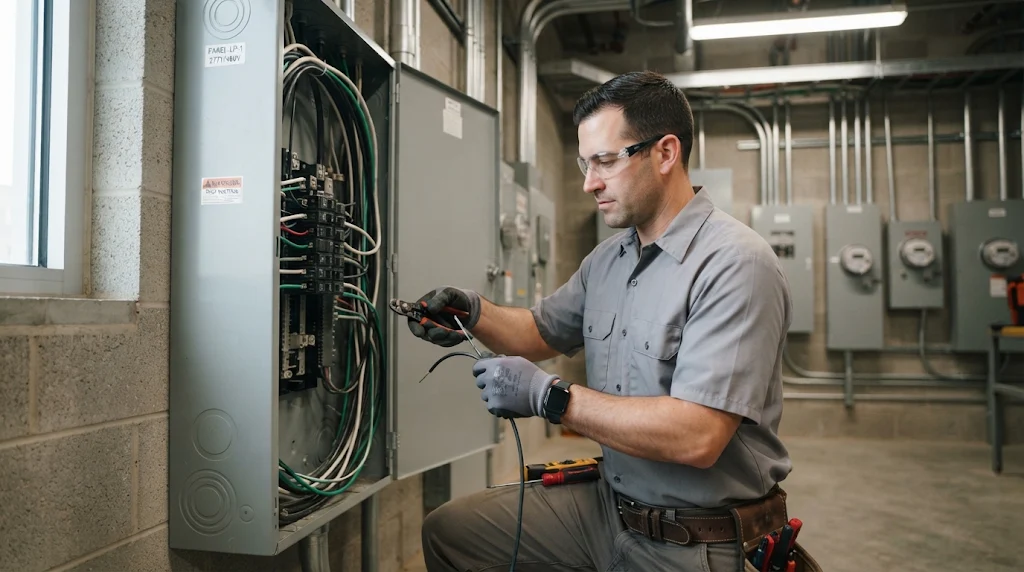
Level 2 EV Charger Installation Services in Lansing, MI
As electric vehicle (EV) adoption accelerates across Michigan, property owners in Lansing require fast, safe, and code-compliant charging infrastructure at home and commercial facilities. While standard Level 1 charging (using a standard 120V household outlet) provides only 3 to 5 miles of range per hour of charge, a dedicated Level 2 240V charging station delivers 25 to 50+ miles of range per hour, fully replenishing battery capacity overnight.
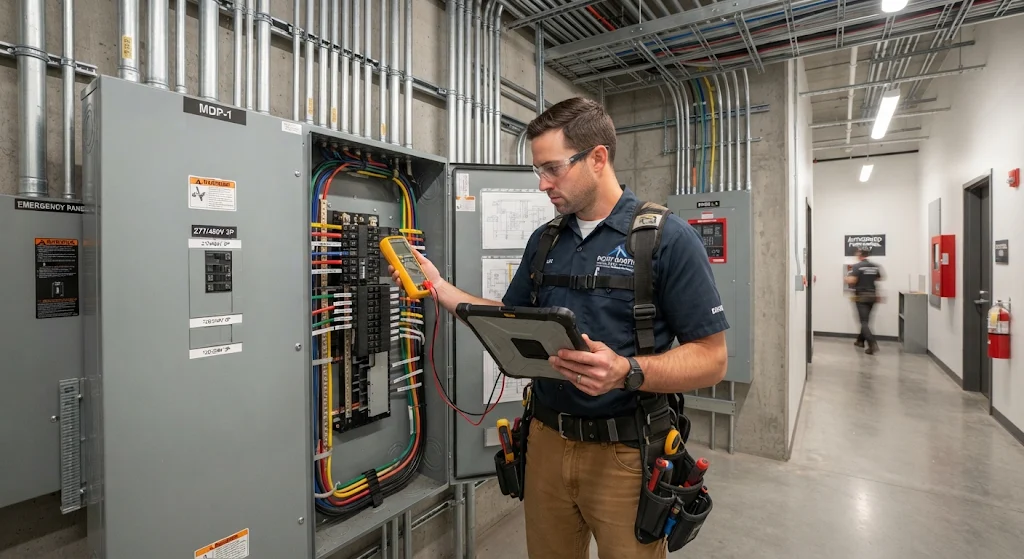
Electrical Requirements for Level 2 Charging
Installing an EV charger is a significant electrical addition that operates as a continuous load under the National Electrical Code (NEC Article 625):
- Continuous Load Rule: EV charging circuits must be sized at 125% of the charger's maximum continuous amperage rating. For example, a 48-amp charger requires a dedicated 60-amp circuit breaker and heavy-gauge copper wiring.
- Electrical Panel Load Assessment: Before adding a 40A-60A circuit, an electrician must calculate existing home loads (HVAC, electric range, dryer, water heater) to confirm the main service panel has sufficient capacity without risking main breaker overload.
- Hardwired vs. Plug-In (NEMA 14-50): Hardwired chargers support higher charging speeds (up to 48A/11.5kW) and eliminate plug wear, whereas plug-in units offer portability but are limited to 40A charging on a 50A circuit and mandate GFCI breaker protection.
- Indoor vs. Outdoor Enclosures: NEMA 3R or NEMA 4 rated weatherproof enclosures and conduit are mandatory for outdoor driveway or carport installations exposed to Michigan snow and rain.
Panel Upgrades & Load Management
In homes with 100-amp service panels, adding a 50A or 60A EV charger often requires an electrical service panel upgrade to 200 amps. Alternatively, smart energy management devices or load-shedding switches can dynamically throttle charging rates when large home appliances are operating.
Permits & Inspections in Lansing
Issued through the City of Lansing Building Safety Office or neighboring township building authorities depending on exact jurisdictional borders. Strict compliance with 2023 NEC / Michigan Electrical Code. Installing an EV charger involves dedicated 240V wiring from the panel, making an electrical permit legally mandatory. Independent contractors ensure all conduit fill, wire gauges (such as 6 AWG copper for 60A circuits), and breaker types strictly meet local municipal code.
Install an EV Charging Station in Lansing
Call WATT911 Michigan connection dispatch at (888) 605-9975. Connect with an independent licensed contractor to assess your home's electrical capacity and install your Level 2 EV charging station.
Commercial Fleet & Workplace Charging
For commercial facilities, multi-family properties, and retail businesses in Lansing, independent electrical contractors design scalable Level 2 and DC Fast Charging (DCFC) infrastructure with networked billing, load balancing, and utility rebate coordination.
Continuous Duty Derating, Conduit Thermal Dissipation & EVSE Communication
Electric Vehicle Supply Equipment (EVSE) represents one of the largest single continuous electrical loads added to a residential system. Under NEC Article 625, EV charging operates continuously (defined as continuous current for 3 hours or more), mandating a 125% branch circuit breaker and conductor rating. Consequently, a 48-amp Level 2 charger must be connected to a 60-amp circuit using minimum 6 AWG copper conductors rated for 75°C or 90°C (such as THHN in rigid metal conduit or EMT).
Thermal dissipation inside conduit runs is a primary engineering factor. When conductors pass through unconditioned attics or along exterior walls exposed to summer solar radiation, electricians apply ambient temperature correction factors from NEC Table 310.15(B)(1) to prevent conductor insulation breakdown. Furthermore, smart chargers utilize pilot signal communication (Control Pilot protocol via SAE J1772 or NACS) to negotiate available amperage with the vehicle’s on-board charger, allowing dynamic power throttling when combined with panel energy monitors.
Capital Region Dual-Utility Grid Dynamics & Institutional Service Reliability
Lansing occupies a unique position in Michigan’s electrical landscape due to the presence of both the municipal Lansing Board of Water & Light (BWL) and Consumers Energy operating across adjacent municipal boundaries in Ingham, Eaton, and Clinton counties. Property owners in Moores Park, Downtown Lansing, and the Eastside must verify their exact utility provider, as BWL and Consumers Energy maintain differing meter enclosure requirements, cold-sequence vs. hot-sequence disconnect rules, and utility interconnection tariffs for standby power systems.
Institutional facilities—including state government office complexes, court facilities, and General Motors’ Lansing Grand River and Delta Township assembly plants—require continuous power reliability and sophisticated electrical switchgear management. Independent commercial and industrial electrical contractors serving the capital area manage high-voltage feeder maintenance, automatic transfer switch calibrations for emergency egress pathways, and energy-management submetering that complies with Michigan Department of Licensing and Regulatory Affairs (LARA) commercial energy codes.